You've read that message three times and you still haven't replied. That's not on you. That's a problem messaging apps have created.
TL;DR: Messaging apps were built for conversation. But a lot of what we actually want to send isn't a conversation starter. It's a short "I'm okay" that closes the loop, not opens one. The trouble is, texting doesn't work that way. Any reply risks starting a whole conversation, and that turns a simple check-in into a mental battle. Calling feels like too much on top of that. That mismatch is why families, long-distance couples, and people in high-stakes jobs all end up needing something a check-in app is built for and a chat app isn't.
Nobody plans to soft ghost their friend (group). It just happens. You open the chat, see forty unread messages, and close it again because catching up feels like homework. Multiply that across every relationship in your life and you get a very Millennial and Gen Z problem: caring about people and avoiding them at the same time (yes, that's possible). It's not out of coldness or malice, but out of exhaustion. Every message feels like it demands your full attention to come up with a reply. And every reply opens up a whole new conversation that you're just not ready for.
That's really the core issue. An "are you okay?" text doesn't feel like a signal, it feels like the opening line of a conversation. So you stare at it, caught between staying silent and sending a reply that might pull you into more than you have the energy for right now.
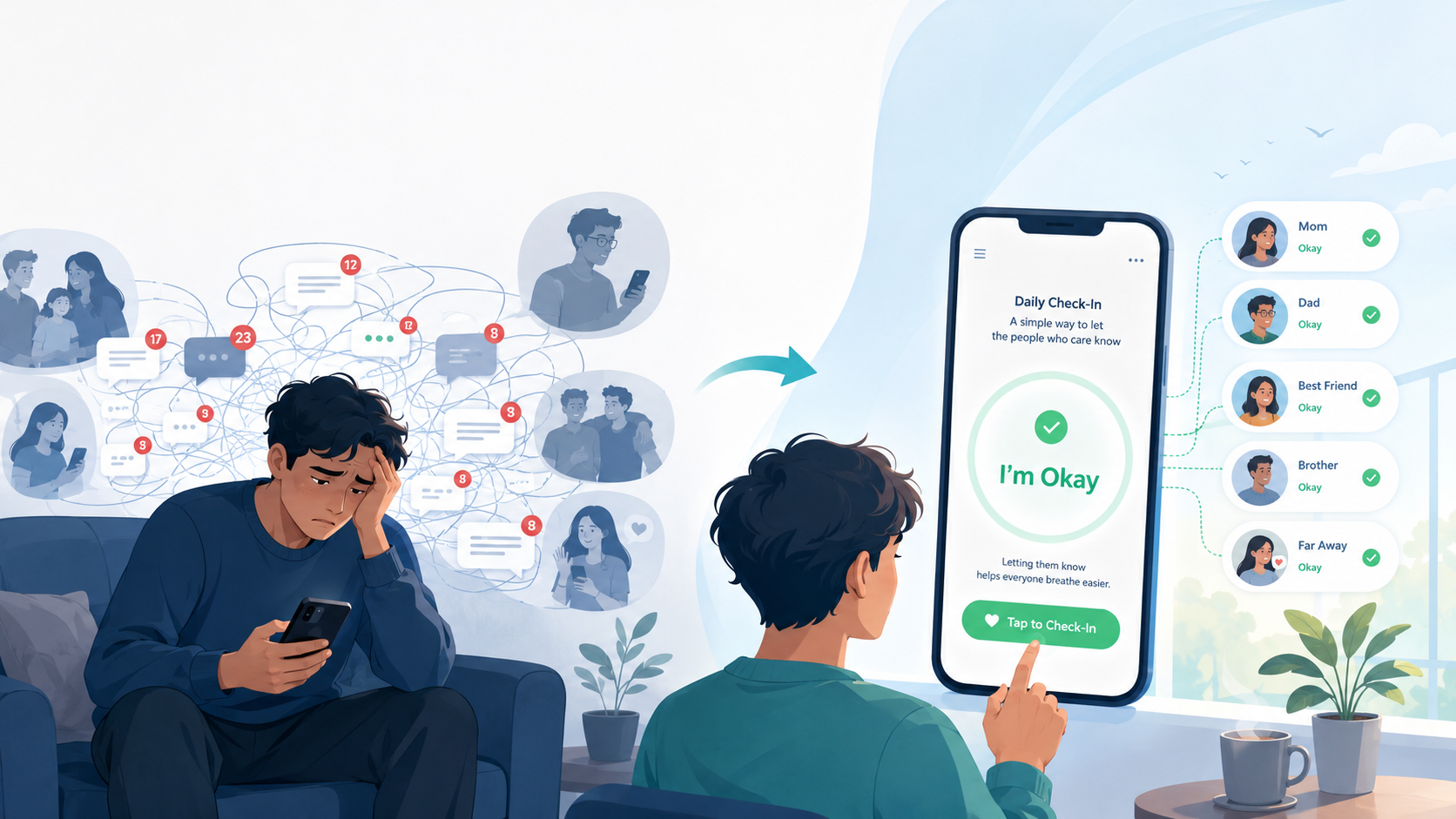
Modern Messaging Apps Create More Pressure Than Reassurance
With the silence stretching on as you debate your next move, a low hum of something that feels like guilt draws your attention back to the unanswered message sitting in your messaging app [1]. It's not the app's fault, exactly. Whether that's WhatsApp, iMessage, or Telegram, years of engineering have gone into each of them. Genuinely impressive tools, good at exactly what they were built for: communication. But that's exactly the problem.
On one end, there's being left on read. Maybe that's you in at least a few of your relationships. Literally on the edge of your seat with worry, waiting for a response that isn't coming. On the other end is being the one who's gone quiet, with no good way to send a reply that doesn't turn into a whole conversation.
These apps weren't built with that kind of care in mind. They know who you talk to, when, from where, and how often. That's just enough data that keeps the conversation running, not for carrying something this personal.
Why Calling Isn't the Backup Plan Either
An out-of-nowhere call from someone you love doesn't read as “just saying hi” anymore. It reads as something might be wrong, and that little spike of dread arrives before you've even answered. [2]
For a lot of people, especially Gen Z, this isn't really about preference. It's about what a call demands: showing up right now, fully ready, with no time to think first. That's not avoidance. It's a mismatch! Texting trained a generation to expect a beat before they speak: time to think, delete, rewrite, even change their mind before hitting send. A ringing phone doesn't give them any of that. [3]
So a workaround got invented: the pre-call text. You know the one, the "Hey, are you free for a quick call?" Considerate, thoughtful, and it just adds a step: now you have to reply before you even get to the actual call. One more link in the chain, and you're no closer to closing the thread.
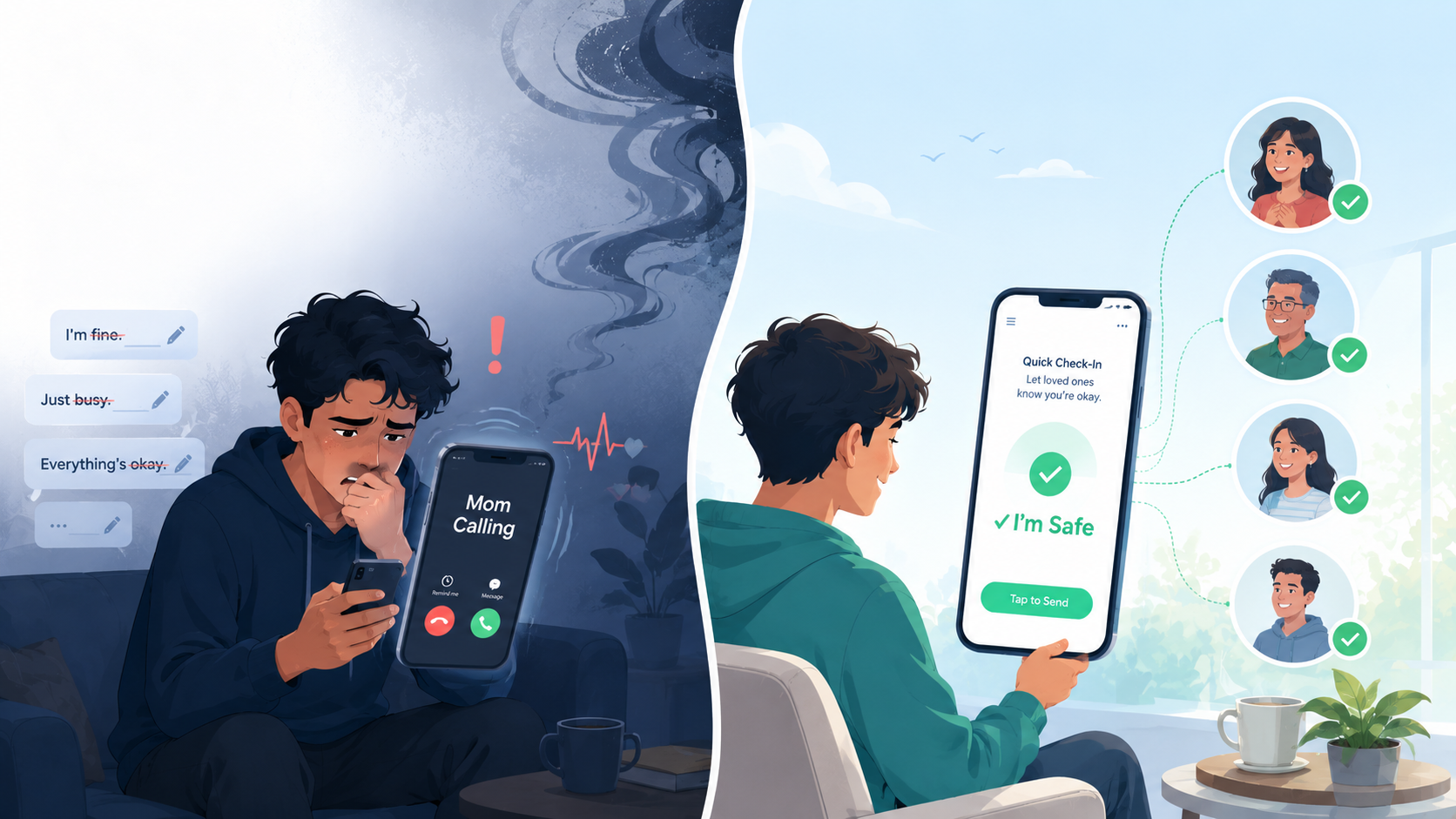
The People Messaging Apps Weren't Built For
For most of us, this is background noise. An occasional worried hour, nothing more. But for some people, not knowing isn't a minor inconvenience. It's the texture of daily life.
- A parent whose child has moved to another city to build their career. Not estranged, not distant, just busy and living their life the way they're supposed to. The communication is warm but infrequent. Sometimes a whole week passes and the parent realizes they haven't heard anything and they don't quite know what to do with that.
- A family member of someone on a long deployment. The windows for communication are narrow and irregular. When a message doesn't come at the expected time, the silence isn't just silence.
- A newsroom editor whose journalist is reporting from somewhere difficult. There are check-in schedules, but they're held together with WhatsApp groups and spreadsheets and a lot of hope. The gap between "last heard from at 4pm" and any kind of structured assurance is wider than it should be. [4]
These are not the same situations. But they share the same shape: someone waiting, someone unable to send a reply, no reliable signal, and no tool that was actually built for this.
Location Sharing Doesn't Bring Peace of Mind
Naturally, some of that need has been quietly captured by “safety” apps that promise to fix all this, for a price you don't see up front. That price is usually your location history.
It's worth being specific here, because it's easy to wave off “they track you” as vague paranoia. WhatsApp's own privacy policy confirms it logs the time, frequency, and duration of your activity, plus who you're contacting and your device and IP information. It feeds Meta's ad targeting across its apps. You don't need anyone to read your texts to build a detailed map of your life. Just tracking the pattern is more than enough. [5]
And more tracking isn't even the fix people think it is. Watching a dot move on a map doesn't bring peace of mind. It just gives you more data to sit with. You watch the dot stop on a highway and wonder if it's traffic or something worse. Tracking doesn't end the worry. It changes its shape. [6]
What We Need Instead of Messaging Apps
The fix isn't a louder app, or a dashboard, or a live map of everyone you love. It's something much simpler: a way to send “I'm okay” as a complete sentence. Not the opening line of a conversation you now have to carry, and not a data trail you have to hand over to say it.
Enter Kin
That's the exact gap Kin fills. A private way to check in with the people who matter most, without the pressure of composing a message or scheduling a call.
No small talk. No “sorry for the late reply.” Just a ping, and a reply that closes the conversation simply saying the one thing that actually needed saying: I'm okay. Thinking of you. Still here.
And because we know exactly how uncomfortable that privacy trade-off usually is, Kin doesn't ask you to make it:
- No location tracking — nothing is stored, nothing runs in the background. If you choose to share where you are, it reaches your circle and disappears.
- Never stored on servers — a shared location is encrypted, forwarded, and gone. No history, no database entry, nothing to leak later.
- Opt-in, zero footprint — sharing is always your call, never a default.
- No unknown users — only the people you've actually verified can reach you. Strangers can't find you here.
- Zero third-party access — we don't sell your data. Ever. Our business model is trust, not tracking.
You don't need another app that watches you to feel safe. You need one that lets the people who matter know you're okay, and then closes that thread. That's Kin.